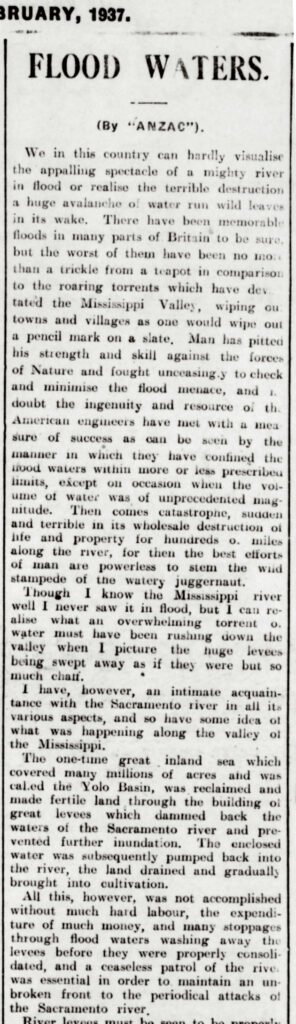
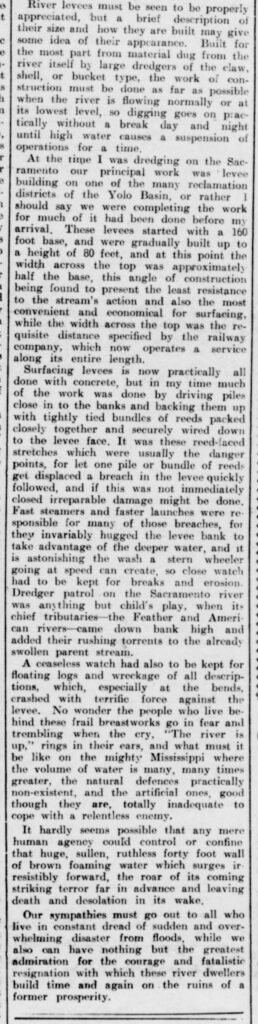
Prompted by a recent news story about flooding in the Mississippi Valley, USA, this factual article, published in the Buchan Observer in 1937, describes the work that Barrowsgate had been involved in while in the USA.
Transcription:
“We, in this country, can hardly visualise the appalling spectacle of a mighty river in flood or realise the terrible destruction a huge avalanche of water run wild leaves in its wake. There have been memorable floods in many parts of Britain to be sure, but the worst of them have been no more than a trickle from a teapot in comparison to the roaring torrents which have devastated the Mississippi Valley, wiping out towns and villages as one would wipe out a pencil mark on a slate.
Man has pitted his strengths and skill against the forces of nature and fought unceasingly to check and minimise the flood menace, and no doubt the ingenuity of the American engineers have met with a measure of success as can be seen by the manner in which they have confined the flood waters within more or less prescribed limits, except on occasions when the volume of water was of unprecedented magnitude. Then comes catastrophe, sudden and terrible in its wholesale destruction of life and property for hundreds of miles along the river, for then the best efforts of man are powerless to stem the wild stampede of the watery juggernaut.
Though I know the Mississippi River well, I never saw it in flood, but I can realise what an overwhelming torrent of water must have been rushing down the valley when I picture the huge levees being swept away as they were but so much chaff.
I have, however, an intimate acquaintance with the Sacramento River in all its various aspects, and so have some idea of what was happening along the valley of the Mississippi.
The one-time great island sea which covered many millions of acres and was called the Yolo Basin, was reclaimed and made fertile land through the building of great levees which dammed back the waters of the Sacramento River and prevented further inundation. The enclosed water was subsequently pumped back into the river, the land drained and gradually brought into cultivation.
All this however was not accomplished without much hard labour, the expenditure of much money and many stoppages through flood waters washing away the levees before they were properly consolidated, and a ceaseless patrol of the river was essential in order to maintain an unbroken front to the periodical attacks of the Sacramento River.
River levees must be seen to be properly appreciated, but a brief description of their size and how they are built may give some idea of their appearance. Built for the most part from material dug from the river itself by large dredgers of the claw-shell or bucket type, the work of construction must be done, as far as possible when the river is flowing normally or at its lowest level, so digging goes on practically without a break day and night until high water causes a suspension of operations for a time.
At the time I was dredging on the Sacramento, our principal work was levee building on one of the many reclamation districts of the Yolo Basin, or rather I should say we were completing the work, for much of it had been done before my arrival. These levees started with a 150 foot base, and were gradually built up to a height of 80 feet, and at this point the width across the top was approximately half the base, this angle of construction being found to present the least resistance to the stream’s action and also the most convenient and economical for surfacing, while the width across the top was the requisite distance specified by the railway company, which now operates a service along its entire length.
Surfacing levees is now practically all done with concrete, but in my time much of the work was done by driving piles close into the banks and backing them up with tightly tied bundles of reeds packed closely together and securely wired down to the levee face. It was these reed-faced stretches which were usually the danger points, for let one pile or bundle of reeds get displaced, and a breach in the levee quickly followed and if this was not immediately closed, irreparable damage might be done. Faster steamers and faster launches were responsible for many of those breaches, for they invariably hugged the river levee bank to take advantage of the deeper water, and it is astonishing the wash a stern-wheeler going at speed can create so close watch had to be kept for breaks and erosion. Dredger patrol on the Sacramento River was anything but child’s play, when its chief tributaries – the Feather and American Rivers – came down bank high and added their rushing torrents to the already swollen parent stream.
A ceaseless watch had also to be kept for floating logs and wreckage of all descriptions which, especially at the bends, crashed with terrific force against the levee. No wonder the people who live behind these frail breastworks go in fear and trembling when the cry “The river is up” rings in their ears, and what must it be like on the mighty Mississippi where the volume of water is many, many times greater, the natural defences practically non-existent, and the artificial ones, good though they are, totally inadequate to cope with a relentless enemy.
It hardly seems possible that any mere human agency could control or confine that huge, sullen, ruthless forty-foot wall of brown foaming water which surges irresistibly forward, the roar of its coming striking terror far in advance and leaving death and desolation in its wake.
Our sympathies must go out to all who live in constant dread of sudden and overwhelming disaster from floods, while we can also have nothing but the greatest admiration for the courage and fatalistic resignation with which these rover dwellers build time and again on the ruins of a former prosperity.”