Memories of the Thirties and Forties
The remininscences of John Duff
In the previous article, I mentioned the Ross brothers in Easter Tulloch, and their ploughing skills. This however, was not all: they, unusually for farmers. were also keen gardeners, always managing to produce the most magnificent leeks and cabbages. Their cabbages in particular were always as hard as a stone and completely untouched by caterpillar. My father was always puzzled by this, and on one occasion managed to get the explanation out of Alan. Perhaps the less said about the leeks the better (it was the era of the dry lavatory), but the explanation for the cabbages would have delighted today’s organic experts. Always in the middle of the neep park, they put in a drill of cabbages, ‘far the beastie couldna’ see them’, and it worked every time. Alan also made heather wreaths for sale at Xmas, and Jim and Bill made ram’s horn and crooks. Sandy Forbes junior I also mentioned. As a young man, he built and operated a sawmill at Newfold, then when his father semi-retired, he moved back to the Brae. He had a big Oliver tractor, used to do a bit of spare time contracting, and in connection with this he built himself a full size travelling threshing mill. So far as I know he had never received any training; he was just one of these people who seem to be able to do anything, and Sandy was certainly never scared of a challenge. The mill, however, must have had a flaw which manifested itself after a number of years’ satisfactory service. One day in the late 40s, my father was at a thrash at the Brae, and returned early, looking a bit sheepish. Sandy’s mill had been giving trouble all day, the fault being unclear, and just after dinner time he had said to my father to, ‘Gie’r a bit mair hunnle, Donal’ (open the throttle a bit). and he would listen to try to locate the fault. Donal had done as bidden, and he said that all of a sudden there was a great crash inside of the mill. and the whole drum, still revolving at however many thousands or revolutions drums revolve at, came straight out through the top, narrowly missing the men there, and landed in the park some distance away. It stopped their thrash. and it was the end of the mill.
Corsindae House was uninhabited at the start of the war, and was in course requisitioned for use a barracks by the Women’s Forestry Corps, a wartime body something similar to the Women’s Land Army, but which received very much less publicity. There were never very many girls there – I would have guessed perhaps about 40, and they used to travel to their work in three ton lorries. Judging by the amount of noise they made when they stopped at the shop for cigarettes, they must have had a hilarious time, and on one occasion I remember them tormenting a lassie who had been in the wrong place at the wrong time and a falling tree had narrowly missed her. At least one of these girls married Iocally and stayed on in Midmar.
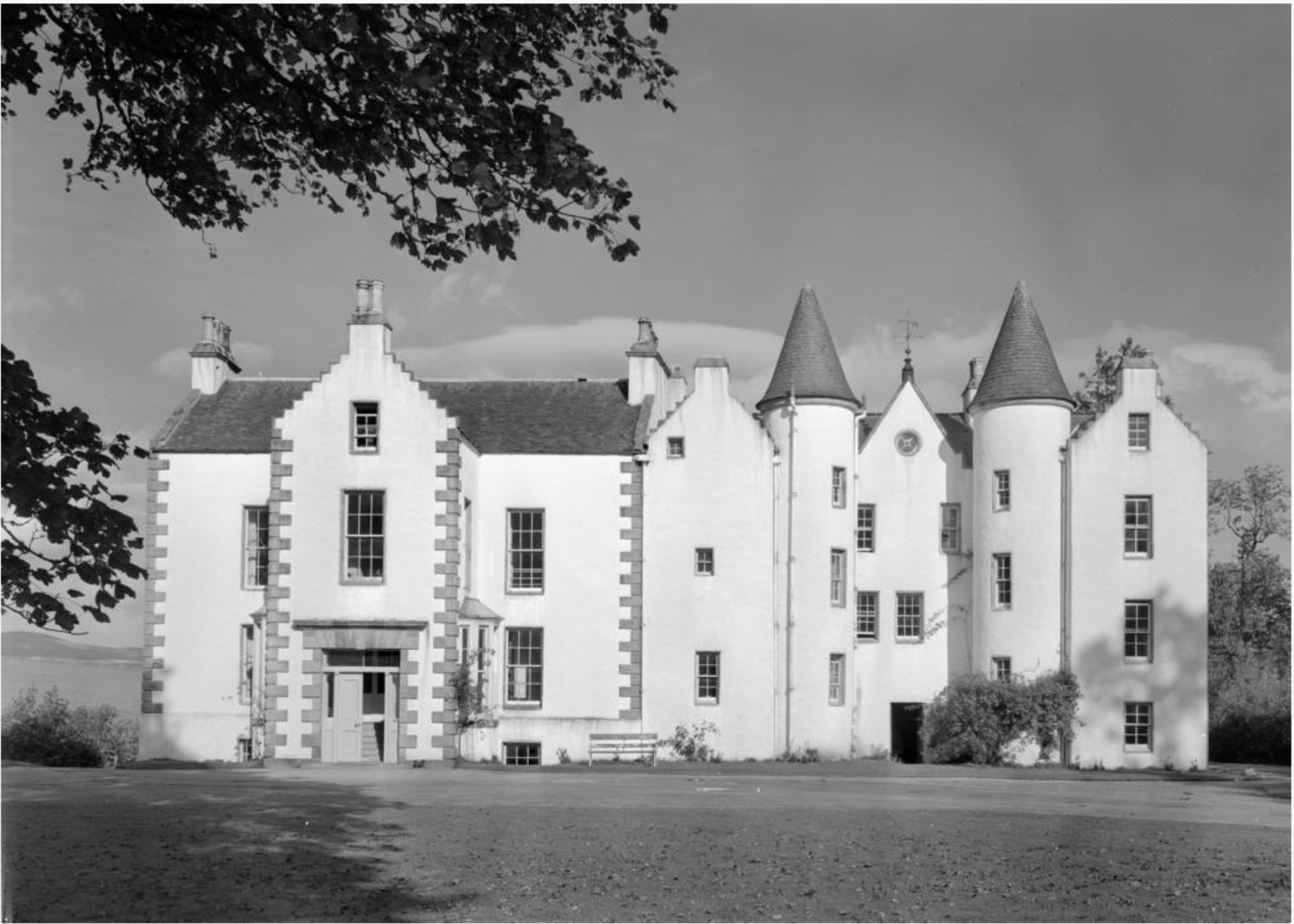
Another memory of Corsindae is of the keeper, a man named Pirie, which we always pronounced Peerie. Pirie was a man or middle age, and I think ex-army. He had a Hercule Poirot style moustache with finely waxed points pointing upwards at 45 degrees, and wild black eyes. When the danger of invasion was at its height, with pill boxes and slit trenches being and dug everywhere, he must have made up his mind that if we were defeated it could be a long war, and regardless of what the Germans conquered elsewhere, they were to be denied Corsindae. He dug two slit trenches right across the main avenue. This might not have been entirely effective in stopping an invading force, but it certainly hindered the people who used the avenue daily. The trenches were bridged by planks till the Forestry girls arrived, then they were filled in. Pirie would have probably been successor to old John McHardy, who was Corsindae keeper for many years, and whose son William rose to become Deputy Chief Constable of Aberdeen City Police.
Of all the animals that passed through our hands, the outstanding character was Bobby, a farm collie far too clever to work very much, preferring to be the family pet. He was the same age as me, and I regarded him as mine. He had the run of the house, in contrast to the dozen or so cats, which were strictly confined to the steading, but much of the time chose to sleep in the barn, or often just at the found of a ruck. This latter sleeping place was for his nocturnal excursions in search of bitches and rabbits (in that order), and since he never bothered livestock, he was just left to get on with it. He was terribly gun-shy, even the sight of a gun sending him helter-skelter to the house, and we thought that someone had taken a shot at him at some time. Although he knew perfectly well how to herd cattle (we never kept sheep), the only duty he seemed to enjoy was bringing in the cows for milking. All that was necessary was to say to him, ‘What about the cows, Bobby”‘, and off he would go, cutting them out from the other cattle to bring them home. He always crowded them at the byre door, where they jostled for position, knowing that he would swing on the tail of the last one in. Cattle can launch a vicious and lightning fast kick, but I never saw him being caught. As far as herding stirks was concerned, he would start off with minimal enthusiasm, and as soon as my father lost his temper and started to shout, as, having no patience, he always did, Bobby would just give him a dirty look and head for home. where he could be sure Mother would take his side. Otherwise, most of his days were spent ensuring his territory was rival-free, which was an onerous task, as the public road ran between our house and steading and the shop was next door, with people (and dogs) coming and going all the time.
His nocturnal expeditions were almost the death of him, as one morning he was found to be missing. One day grew to three, and we had almost given up hope, when, on my way over to get Granny to read my Dandy to me, I met him on the footpath between her house and the shop. He was very near to complete collapse, filthy, dehydrated, and crawling along, dragging a gin rabbit trap complete with baikie (peg), on a front foot. He must have spent his missing days struggling to get free. His foot was terribly injured, with the bones and toes partly severed. Nowadays, the next stop would be the vet’s surgery, with hundreds of pounds spent on treatment, but in those days money was a great deal more scarce. Vet’s fees were considered justified for the higher animals like horses or cattle, but cats and dogs just lived or died as fate (or sometimes a twelve-bore) decreed. Nevertheless, all the domestic stops were pulled out, and although he very nearly died, he was soon back on his (three) feet again. His injured paw was bathed with disinfectant daily, and it must have been very painful, as he used to cry out, but he never tried to pull back his foot or bite. Father even made a sort of boot for him out of the leg part of an old Wellington, but he always managed to get it off. Gradually the foot healed after a fashion, leaving him with two or three toes replaced by a bald black lump, and he just carried on before, with the exception that if anyone enquired after his “poor sore footie”, he would hold it up and whine. When he was old, and perhaps a bittie dottled, he would sometimes make a mistake, and offer the wrong foot, but he never forgot his injury. He finally died in his bed. aged 15.
Bob the horse was scarcely less of a character. He was a big middle aged Clydesdale gelding, and had previously worked in the wood for old John Murray, where superior intelligence had enabled him to avoid the wracking injuries to which wood horses were so prone. Completely gentle, if thrawn to a fault, he disliked the plough, and would only go at his own speed. His inbuilt clock was very accurate, and if he considered that lousing time had arrived when he got to the fleed, the hamewith road was the only way he would go. He was also very fussy about pedicare, and would only allow himself to be shod by a smith of whom he approved. On one occasion my father left him with a temporary smith who had ‘never been beaten by a horse yet’, and Bob arrived home about five minutes after him. Seeing the set-up, he had just quietly broken his tether and walked out of the smiddy. He was the ideal beast for a boy to learn with, (or perhaps it should be from), as he knew exactly what to do, whether in dragging coles of hay or carting neeps, and was very tolerant of his youthful drivers’ attempts at adult chirps, ‘Gittups!’, ‘Woes!’ , ‘Hies!’, or Weeshs!’, all of course followed by the mandatory ‘Min’. If he was in theats, too, it was great to get a hurl home on his broad back, leggies nearly doing the splits to reach his sides. I don’t remember Bob’s departure in Frank Robertson’s float – probably I was at school – but at his age he had no hope of another job, and his journey could only have had one end, which I hope was very quick. He was a great horse, and I’m sure he made great boots.
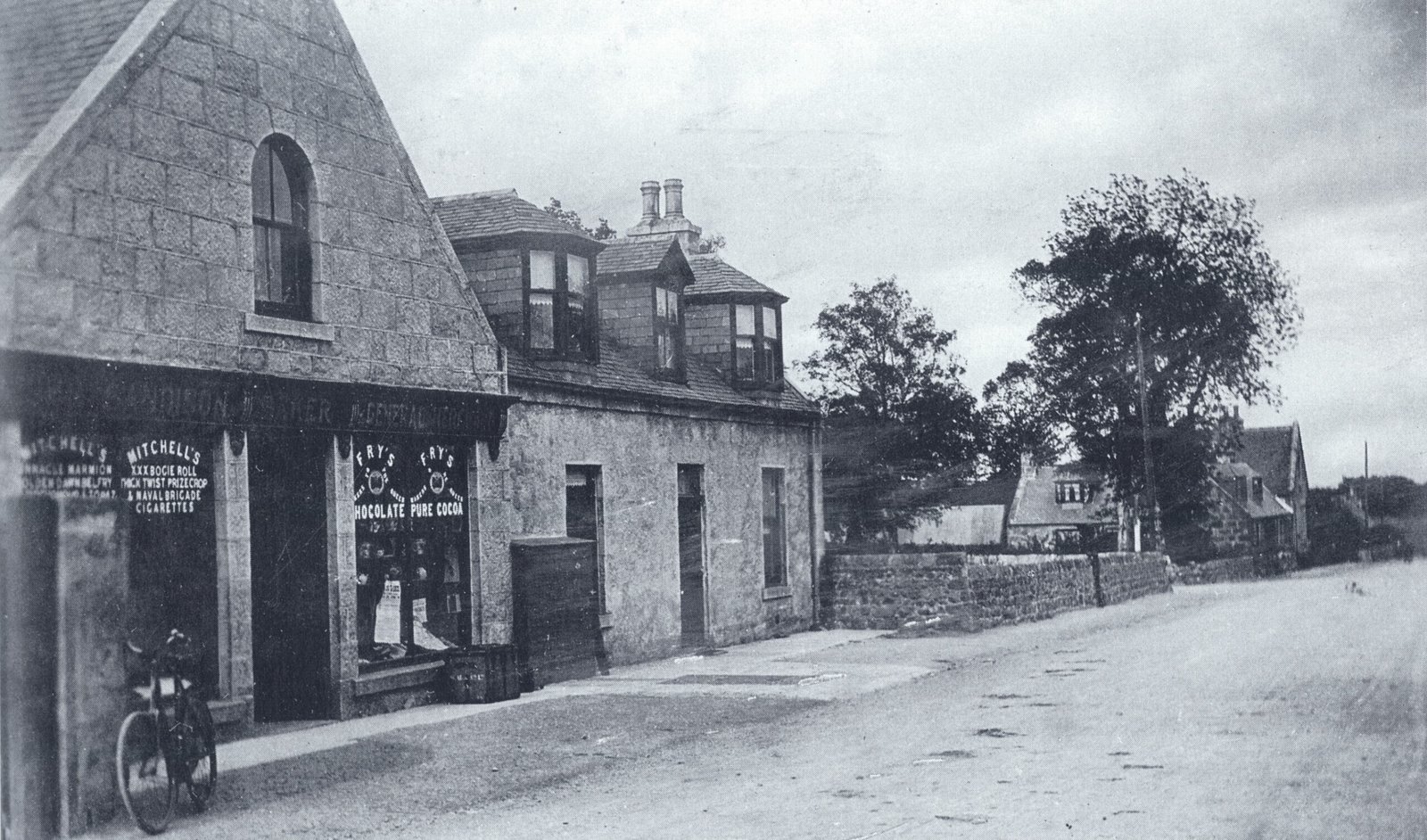
The higher ground of Midmar was always noted as a stormy area, and Iocal wisdom had it that the bad weather started at the ‘twa trees’, which were two big ash trees, both long gone, on either side of the roadway just east of The Cottage’ shop, ‘Licensed to sell Porter and AIe’ (now the Midmar Inn).
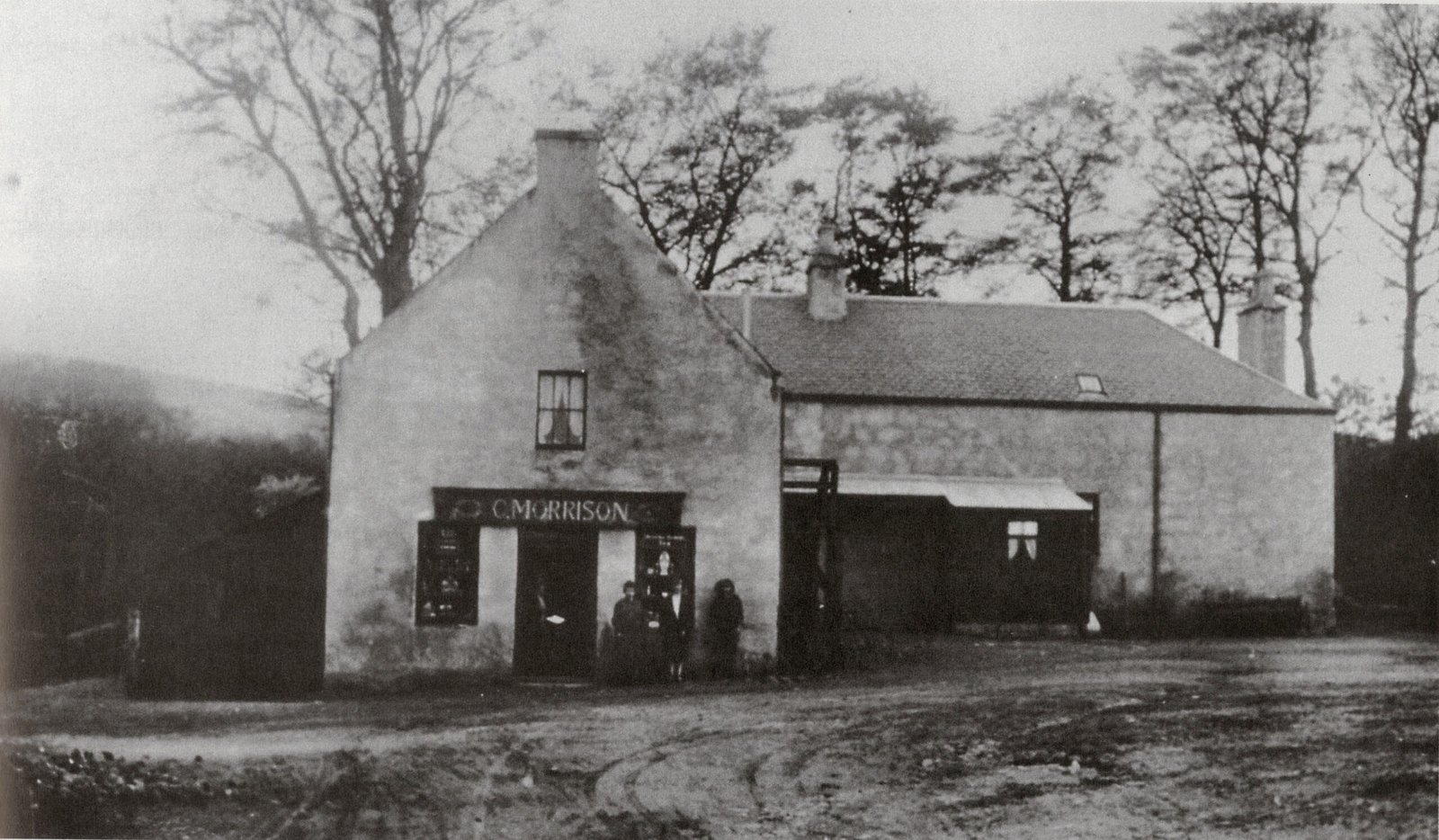
There were several bad winters towards the start of WWII, which were never very fully reported, partly because other events took priority, and partly for reasons of national security, the Government not wanting to publicise the extent of transport dislocation. The one I remember most was, I think, that of 1942/43, just after Dominie Montgomery came to Midmar. The school must have been closed, but probably not for long, as in those days, immediately the weather had moderated, even if the roads were blocked, pupils would start coming back to school, the nearer ones first, walking along the top of dykes or through fields. I would have been 9 at the time, and I remember being forbidden to leave the house. Everything outside was just a howling whiteness, and when my father went to the byre, he disappeared from view two or three steps from the house door. At that time, the old school had a big masonry wall along the roadside, about 7 feet in height at the Schoolhouse end, reducing to about perhaps 5 feet at the School Cottage. On the opposite side of the road was a beech hedge which was about 15 feet high, never having been cut back. On this occasion, the wind direction caused the roadway between the wall and the hedge to completely fill with snow, far beyond the ability of any snow plough to clear. The snow ploughs in use then were quite small, and big squads or roadmen used to go ahead, hand casting the drifts that the plough could not move. At the school, the huge accumulation of snow had to be tackled in two cuts, with men at road level throwing up the blocks of snow to their mates on the top cut, who then threw it clear. Later, the beech hedge was cut down to a height of 3 feet, and now of course most of the wall has gone. When the plough was finally able to clear the road, we were taken into the dominie’s room to watch Sandy Greig, the local Council lorry driver, butting his way through the lesser drifts. It was quite spectacular to watch, because Sandy, with a big backlog of roads to clear, was giving it a lot of stick, and I remember Monty likening the flying snow to the bow wave of a destroyer on the high seas. None of us had ever seen the high seas, let alone a destroyer, but we knew exactly what he meant, and agreed.
The great storm of 1947 is by far the worst I can remember, not only because of the absolute volume of snow which fell, but also because of its lateness, its long drawn out nature, and the peculiar combination of weather, lack of adequate machinery, and the use of farm tractors, which made roads exceptionally difficult to clear. So far as I can recall, the winter had been fairly normal till February 10, when there was a bad snowstorm which blocked all of the toads in Aberdeenshire, Buchan being hit particularly badly. No buses were to run thereafter between Aberdeen and Tarland for 10 weeks. The Roads Department was completely swamped, and Polish soldiers from a camp in Buchan were drafted in to help clear roads. After a day or two, most roads were cleared, and the weather alternated between frost and thaw, till Thursday, 26 February, when driving rain gradually changed to dry snow, with gale force winds. A service bus trying to tum at the Midmar road end stuck, and could not be recovered for several weeks. This storm, as well as being particularly fierce, covered the whole of the country, the local press reporting that no less than 150 important roads in Scotland and England were blocked. From Aberdeen, only the Dyce and Culter buses were running, and at Braemar , the snow was feet deep and still falling thickly.
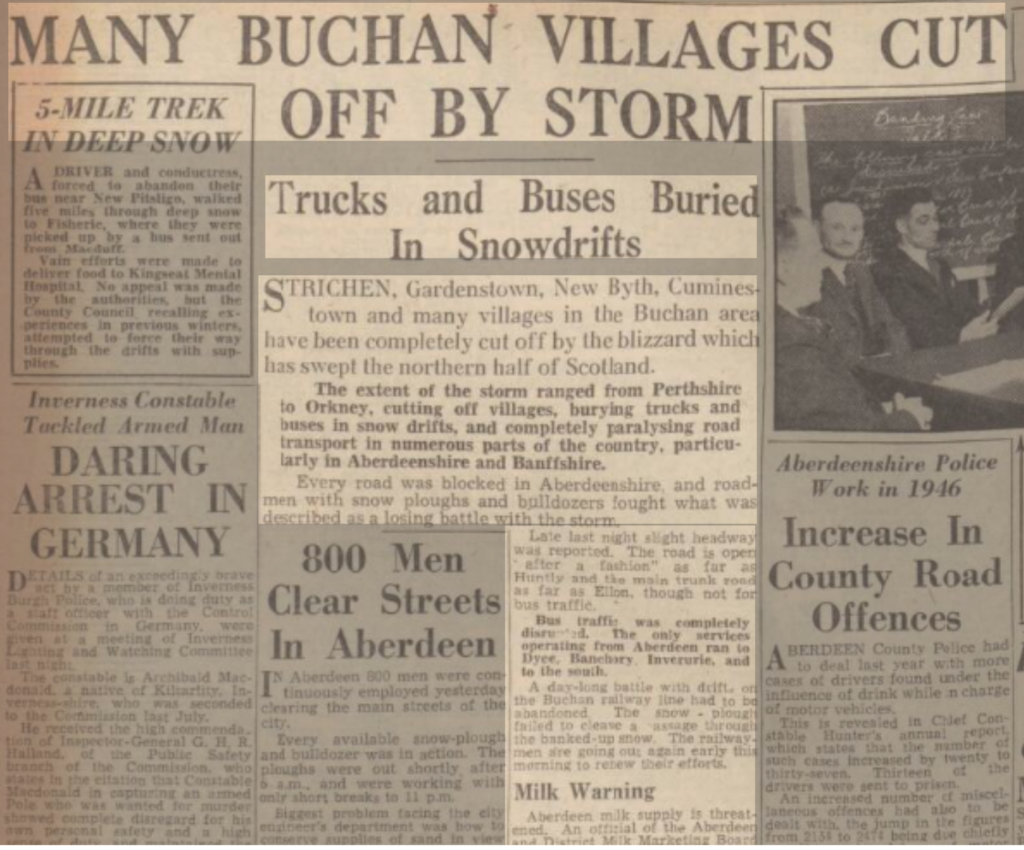
All this was bad enough, but it was happening at a time when Europe was desperately struggling to recover from the war. There were still millions of homeless and starving people on the Continent, and at home, there was no chink or light to seen in the universal gloom. Polish soldiers in camps throughout the country were rioting because they could not go home, coal shortages and power cuts were the norm, scarce food supplies were being diverted to mining areas in an attempt to boost coal production, rationing of course was still very much in force. and the Russians were ever more threatening. And at Birley, our store of neeps was shrinking fast.
Within a few days. things started to improve, and by 01 March, the Tarland buses were running as far as Echt. By this time, I was attending school in Aberdeen, and much to my disgust was sent to lodge temporarily with an aunt there. Jimmy Esson and Kenny Miller were going to Echt for groceries with a pair of horse and the Newton muck sledge (brushed out and straw lined), and to catch the bus I got a lift from them. On the way, they had to pay their respects at the Cottage, and my wait outside for them was finally proved worth while when Mrs. Smith came out and gave me some stuff in a glass. I don’t know what it was, but it fairly shortened the road to Echt! I think that this particular sledge trip was a (successful) re-run of a disastrous previous attempt by some of the local men. On foot and carrying pillow cases to carry their purchases, to get supplies from Sandison’s bakery, they had called at The Cottage, then, having bought their loaves and imps at Echt, had thought it a shame not to visit the Cowdray Arms. On the way home there was another refreshment stop at The Cottage, and from there on their erratic progress westwards was marked by a trail of or abandoned comestibles.
Nearly all of March continued Stormy, with alternate frost and fresh. Most of the main roads were opened within a week or two, but the side roads took much longer. Farmers started to take horses and tractors over the snow, and the variable conditions ensured that the trampled snow in due course turned to solid ice. Proper snow clearing equipment was simply not available, and finally bulldozers were used on some roads, often causing further damage. Even after the roads were opened, there were such potholes in the residual ice that Alexander’s refused to run their buses on some routes. The snow in the fields was like a blanket, levelling off dykes and palings. The surface was frozen so hard that Sandy Forbes found that he could drive his Hillman 10 car over everything. Until one day, that was, when rotten snow gave way and the car was left balanced on top of a dyke, posing an interesting recovery problem. Other enterprising forms of transport began to appear and one of the younger farmers had a newly broken clip which he harnessed to a makeshift sledge made from paling posts with backs nailed across. The sight of this menage coming tearing along, the sledge slewing wildly from one side of the road to the other, the horse’s mane and feet flying, with Jehu himself desperately hanging on to his chariot while trying to control his steed and at the same time dodge the huge divots of snow thrown from its feet, is unlikely ever to be repeated. Traction was by means of theat chains alone, so goodness knows how a stop was effected – presumably like an oil tanker, he started to slow down a long time before the destination was reached.
Inevitably, there were human dramas. One lady from a fairly remote cottage was taken critically ill at the start of the storm, with no hope of any ambulance being able to get near. The possibility of taking her out by sledge, well insulated with hay, was discussed, but it was finally decided that she was just too ill to risk it. Dr Eadie, the Echt doctor, walked up daily to attend her – a round trip of ten miles, and she finally recovered completely. He was a keen shot, and always took his dog and gun with him. Bluff and jovial, on his first visit he showed the patient his gun and told her it was for her if she did not improve! Few doctors would have attempted his feat, but he was dedicated to his patients, who thought the world of him. No one would have dreamed of challenging his right to shoot wherever he wished, and he knew that he was more than welcome to share a meal at any house he passed. He never learned, however, that it was not etiquette to take your dog into a house without being asked. On one occasion, he and his Labrador came marching into our house, and of course Bobby immediately flew at the lab. Completely unflustered, he grabbed a dog in each hand by the scruff of their necks, throwing his one outside and ours into the kitchen, and carried on as if nothing had happened. In the course of conversation, Mother happened to mention I had a slack front tooth (which I was milking like mad for sympathy), and or course he had to see it. All of a sudden, while looking at it, he jerked his finger and knocked it out. I found it very hard to forgive him for having assaulted my dog and then me, all within minutes.
Our own domestic arrangements were not affected a great deal by the storm, except that Mother had to bake more. At that time, the bakers van called twice weekly, and the butcher once, so we were not all that dependent on them. We always had meal in the girnal, and a stock of flour, so the only thing we really missed was bread -‘loaf breid’. In the interim, girdle scones, pancakes and oatcakes did very well. For fresh meat, there were rabbits, a few hens were sacrificed, and my father kept his gun in the barn to shoot hungry partridges on the rucks. For all that we were living on the very best of home grown produce however, bully beef with neeps and tatties, or hairy tatties with mustard sauce, we regarded as a special treat! The farm animals fared less well, as our neep store ran out and Father had to his days for a while digging up neeps and then carrying them in a bag on his back up the top of a dyke. Even after the thaw did finally come, the park was so wet that not even the horse could work, let alone the tractor. The horse troch was frozen almost solid, and the stable pails had to be filled at tea time and taken into the byre to let the ice thaw out a bit for morning. The spring work was incredibly late, of course, and on the longest day, while ploughing an end-rig on a back-lying bit of our top park, my father was breaking snow behind a dyke. Nature came to the rescue, however, as the summer was exceptionally good and the harvest was normal.