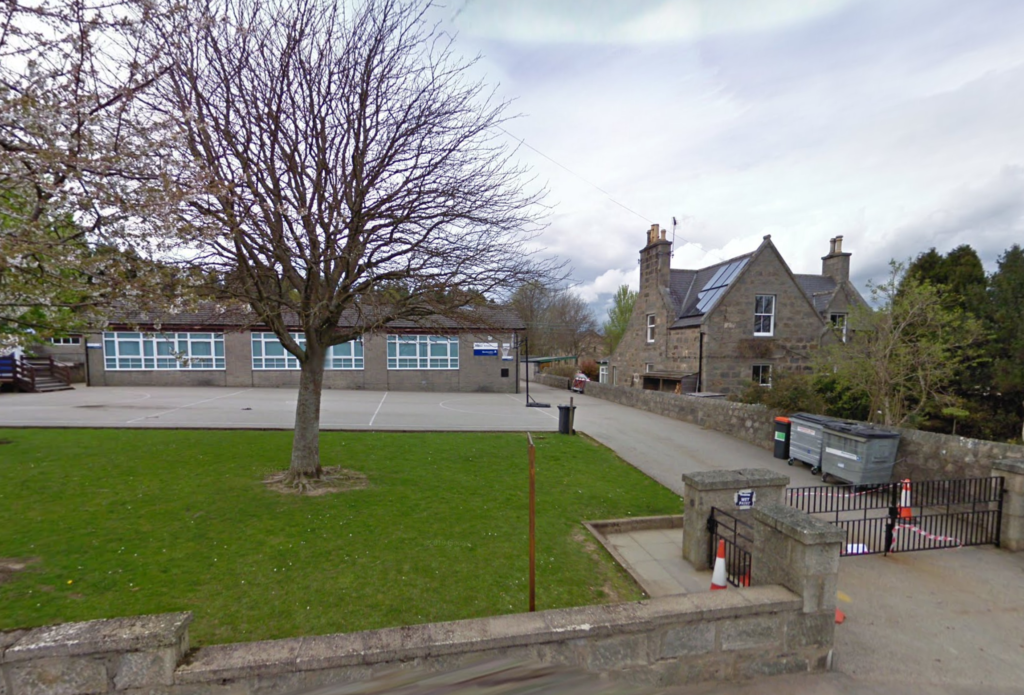
Memories of the Thirties and Forties
The remininscences of John Duff – Schooldays
We were fortunate in that our house was only a short distance from the school , but some pupils had two miles or more to walk, to say nothing of the fact that a number of the boys used to arrive at school with sharny boots through working in the byre before setting off in the morning. In the winter term, those who could not go home for their dinner got soup in enamel bowls from the school soup kitchen, carried in buckets by the older boys. The kitchen was a room at the gable end of the boys’ shelter, fitted out in very basic fashion with a coal fired wash-boiler for cooking the soup, a sink with cold water tap, and shelves. The cook that I remember best was Flo Anderson, mentioned previously. Flo was a big, cheery person, whose trade mark was the navy tammy she usually wore. She was much in demand she was honest, clean, and prepared to work inside or out, although I think she really preferred outside work, at which she could compete with most men. Her soup, commonly broth or tattie soup, was excellent, and she coped good-humouredly with the play-time influx or boys eager to steal a bit of carrot or neep, or in cold weather, just the warmth. The lavatories were at the back of the playground, and the boys’ ones at least were quite indestructible. There were about three cubicles, plus a concrete urinal, and no one lingered! Water seemed to permanently turned off, which it probably was, as the school had its own supply, pumped by a water hydram at the ‘Mirey Wallie’, now anglified, I believe, to ‘Mary’s Well’, and water could well have been scarce. The Dominie used to have to trudge the half mile or so to the well each day after school, to bleed air from the cylinder of the ram. Pre-war, there were three teachers. The infant teacher was Barbara Greig, a very gentle. patient and dedicated woman, with a habit of seating herself on the guard in front o’ the big open fire. The smell of her backside singeing is one of the clearest of my childhood memories. We all had slates. of course. and ownership of one with the top part marked off in squares ensured a high place in the order. ‘Britannia’ skylies or slate pencils, which came in boxes of five, were considered best. To clean our slates. we carried little bottles of soapy water. along with ‘weet cloots and dry cloots’, which stank abominably if not regularly changed. Events in the Christian calendar were illustrated by big posters on the blackboard. Christmas, in addition to the Shepherds and cribs, was Good King Wenceslaus, wearing a red dressing gown, and with his crown well scrugged down over his lugs, leading a smug-looking page up a hill in blin’ drift, while Easter was Jesus on the cross. We sang appropriate hymns, and while I always felt a bit regretful that the green hill was without a city wall, I could never quite understand why it needed one in the first place. Miss Greig taught at Midmar for about 40 years.
Miss Robertson’s room was next door, and housed the library bookcase (opened on Wednesday afternoons after school) with its plaque commemorating Andrew Carnegie and on one wall, a large oil painting of a young looking Miss Catherine Fyffe-Duff of Corsindae (1859 to 1915) seated on a grass bank and holding a bunch or primroses. The move to this room marked the start of discipline, because Marjory Robertson was a sonsy deem with a quick temper, an acid tongue, big muscles (well, I thought they were muscles), and a strap. She did things other than draw lines with the edge of a ruler, and it was as well to keep the hands below the desk if she was on the warpath. For all that her tongue, which, rapier-like, was far more feared than her other she was essentially very kind. It was just the tongue. On one occasion, a child, I forget whom, had been off school, and Miss Robertson, suspicious, demanded a note from his parents. This duly arrived, saying he had suffering from his nerves (this in itself was asking for trouble, as ‘nerves’ was certainly not on the list of ailments that pre-war children could legitimately suffer from). She was on to it like a stoat with a rabbit. ‘Nerves!’. she snapped, ‘It’s nerve you suffer from, boy, not nerves!’ She and Mis Greig, always known jointly as The Missies’, lived together in apparently perfect harmony in the one cottage attached to the school, and few teachers could have been more respected than they. It was a sad day when Miss Robinson contracted cancer and died an untimely death in 1949. The strap was never the terrible instrument of torture it is nowadays made out to be. It was certainly painful. and so was a powerful deterrent, but the punishment was all over in seconds, and if the tears could be held back, some kudos could obtained through ‘bravery in the face of the enemy’. While waiting for the nip to leave numb hands, it was nice to think, ‘I ‘niver grat’, or sometimes more accurately, ‘I niver grat muckle’. Teachers all had their ‘Lochgelly’ strap, but it was seldom used on girls, and most boys just looked on it as one of life’s natural hazards, like being kicked by a stot or bitten by a ferret; avoidable in theory, but not always in practice.
We kept four milch cows and sold milk Iocally, this being dispensed in small galvanised pails. The Missies got their milk from us, and my sister and I had to deliver it in the morning and collect the empty pail at night. In due course this duty devolved on me alone, and I hated it, despite the fact that always got at least sixpence from them each week. Weekdays were not too bad, but on Saturdays Miss Robertson (it always seemed to her) would want errands from the shop, and since this ate into valuable time that could be spent on the innumerable things that country boys did on Saturday mornings, I used to creep up to the door, grab the pails and quietly retire, hoping they would not notice me. If this stratagem was too successful, Miss Robertson would get her birss up, and when she did catch me, would indulge herself, pointing out that I was a sneaky, idle, underhand and thoroughly worthless child, heading fast for a bad end. and that she wanted this, that and the other from the shop. Demoralised by my failure, my ego flattened, my character shredded, my whole morning ruined, I would then depart, snivelling, but doggedly clutching my sixpence. Never be a milk boy.
The next door room was separated from Miss Robertson’s by a folding partition so that the two could be used as one. This was particularly significant during the war, when there was no public hall, and all functions were held in the school. This room was empty pre-war, but was used after the evacuees arrived. Off it was a large porch for the boys, which contained coat pegs and the ‘piece box’, a wooden box like a farm servant’s kist, in which were thrown any crusts or other unwanted bits or sandwiches. It was usually emptied before the summer holidays (not very much was thrown away), and it was advisable to hold the breath before lifting the lid.
Across the ‘little eens” playground from this porch, and connecting with Miss Greig’s room, was the dominie’s room, where Dominie John Walker presided. This was a multi-purpose room, which housed a black cooking range at one end of the room and an ordinary open fire at the other. Miss Robertson taught the older girls cookery here on one afternoon a week, while the dominie taught the 1K’ys woodwork in the same room. The woodwork was meant to be of a practical nature, and there were miniature farm gates and other model rural carpentry on display. The woodwork benches doubled as school desks, and as such were prized and squabbled over by the older boys. In one comer was a big square sink with a lot of the glazing worn off, and this was where the school dentist, on his periodic visits. pulled teeth. There were no fillings: teeth were either left alone or pulled. The last item of interest was the school wireless, which lived in a large cabinet, along with its associated batteries. I never actually heard it working. Early in the war we were all taken into the dominie’s room to hear something important (I think it may have been Churchill’s ‘fighting’ speech), but all that could be heard were crackles and howls of static. Inconsiderately, war was declared in the middle of hairst. We had no wireless, but my granny had one, and I remember aunt Carrie coming across to the hairst park to tell us. The adults looked glum and serious, and spoke together quietly for a while – the of bloodbath of the First World War was only 20 years distant. In late October of that year, the evacuees arrived from Glasgow, and we stood at the house door one evening and watched three buses of waving children and adults driving to the school, from where the children were billeted with families who had room.
Between thirty and forty evacuee children, mostly from Clydebank, came to Midmar, and the culture shock on both sides was considerable. The first thing to break down was the dominie’s admission register. Completely swamped, he just recorded names, missing out most of the usual particulars. One family was billeted with an old fashioned couple, and came down for their breakfast on the first morning to find a big cog of brose in the middle of the table and a spoon at each place. This caused a bit of amusement locally, the general consensus being that they could have been given a bowl each on their first morning. These incomers were almost totally ignorant of country life, many of them being unable to distinguish between different types of poultry, and some thinking that hens grew up to turkeys. We ridiculed them, of course, never stopping to think that would have been even more lost in Glasgow, and there were frequent fights. Many of ‘vacs’ disappeared within a few weeks, but others, having learned all about ordinary brose, neep brose, kail brose beef brose and the vile ‘pizzers’ (peasemeal brose – allegedly rich in iron: “Ait up yer pizzers, laadie, they’re gweed for the bleed!”), stayed on for the duration, and the original brose family were still coming back to visit their foster parents long after the end of the war.
With the evacuees came teachers who also frequently failed to stay the course. Most lodged with Carrie Murray – Miss Adam. Miss Moggagh and Miss McKenzie are the ones whose names I remember. Jessie McKenzie Stayed longest. She was a chain smoker who smoked Craven A cigarettes, breathed nicotine fumes and always seemed to have shreds of tobacco stuck to her lips. The children who stayed settled in surprisingly well, although some were real toughies. One family of three stood out. The two boys were inveterate fighters, and their sister Meg was a big, precocious lassie with raven black hair, as if she had Mediterranean blood. Miss Robertson could control them all right, but with Miss McKenzie, it was a ‘no contest’. If she were inattentive, as she usually was, and Meg was in the humour, as she usually also was, she would respond to a crude whispered request by giving practical anatomy lessons to the loons in the desks behind. On balance, I think her classes were more instructive than Miss McKenzie’s. Another of her favourite tricks in the summer, on the way home from school, was to gather a handful of choice geans or rasps, urinate on them, then offer them to a carefully chosen victim. Success triggered paroxysms of raucous laughter. Meg was a lassie who clearly had a considerable past in front of her, but she returned to Glasgow before proving it.
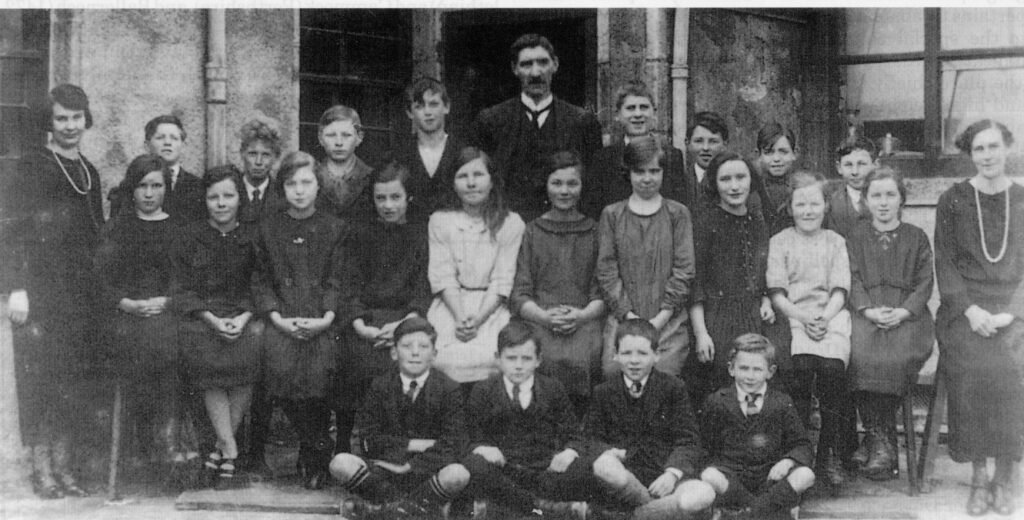
Dominic Walker was an elderly man with a heavy moustache and a rather sad expression, possibly because he spent most of his break periods repelling boys looking for lost balls in his back garden. In 1942 he retired, being replaced by Dominie Donald Montgomery. The new man, a native of Harris and with Gaelic as his first language, was the first genuine ‘heelanman’ most of us had ever seen. His previous school had been Lochcarron, and since he also had a pronounced highland inflection, pronouncing James as ‘Jamus’, and so on, he was a considerable novelty. This sense of novelty was greatly intensified when his father came to visit him. Mr. Montgomery senior was a tall, erect and fine man of perhaps about 70, who his son assured us still had every one of his own teeth. Much more remarkable to us was the fact that he had little or no English, my recollection being that he could not converse other than in Gaelic. ‘Monty’, young and energetic, was soon to be seen cycling all over the place, and settled in well, although he did initially express some confusion that chaff should be called ‘caff’, a calf a calfie, and calves ‘carr’. Early on, he made changes which considerably affected school life. Firstly, he allowed pupils access to the dominie’s park behind the shelters, thus vastly increasing the play area, allowing the sexes to mix (previously the girls had formed an alien and rather hostile tribe in their own playground, intent on their own esoteric pastimes), and perhaps not least, reducing the ball nuisance in his garden. Secondly, although I think this was probably just Education Authority policy, part of the ‘Dig for Victory campaign, he started a school garden, where we learned what a parsnip was. Thirdly, he became an enthusiastic beekeeper, and filled his back garden with hives, finally and completely deterring the ball hunters. After this, the woodwork classes were very much oriented towards hive making, and pupils who were interested were given willing instruction in beekeeping.
Donald Montgomery was a mercurial teacher, if somewhat prone to black moods, he had a gift with words, and his almost boyish enthusiasm for whatever ploy he was currently engaged on never failed to communicate itself to his pupils. He did however have a rather disconcerting habit of throwing things at errant pupils. Usually it was chalk, occasionally the wooden- backed blackboard duster, and on one never-to-be-forgotten occasion, goaded beyond endurance and roaring like a lion, he launched a box of nails at the bad boy. Davy narrowly missed decapitation, and after picking up the nails, paid rather more attention for a while.
One Sunday towards the end of the war, the dominie took about half a dozen of us out on a bike run over the Learney Hill to Torphins, where we had ice cream at the then Star and Griffon Cafe, then cycled by Kincardine O’ Neil to Potarch Bridge, where we studied the water and saw a big eel wriggling about, before returning home. We must have been an odd looking bunch. Monty himself had a sports bike with semi-droop handlebars, but the rest us just had whatever machines we could lay hands on, all old and mostly too big, and of course everyone was in a state of fevered excitement. I mention this humble excursion, which would of course be scoffed at by today’s bored and sophisticated youth, only because to us, most of whom, apart from an occasional trip to Aberdeen, had never been more than walking distance from our own doors, it was, in terms of adventure. novelty and exploration, at least the equivalent of a modern foreign trip. I think it made a lasting impression on all of us, and I have often since then wondered if the dominie realised just how memorable an experience his sacrificed Sunday gave to his charges. A few weeks later, still all fired up with enthusiasm, a few of us made another expedition to the Inn at Monymusk, but it wasn’t quite the same without Monty in charge to boss us about and explain things.
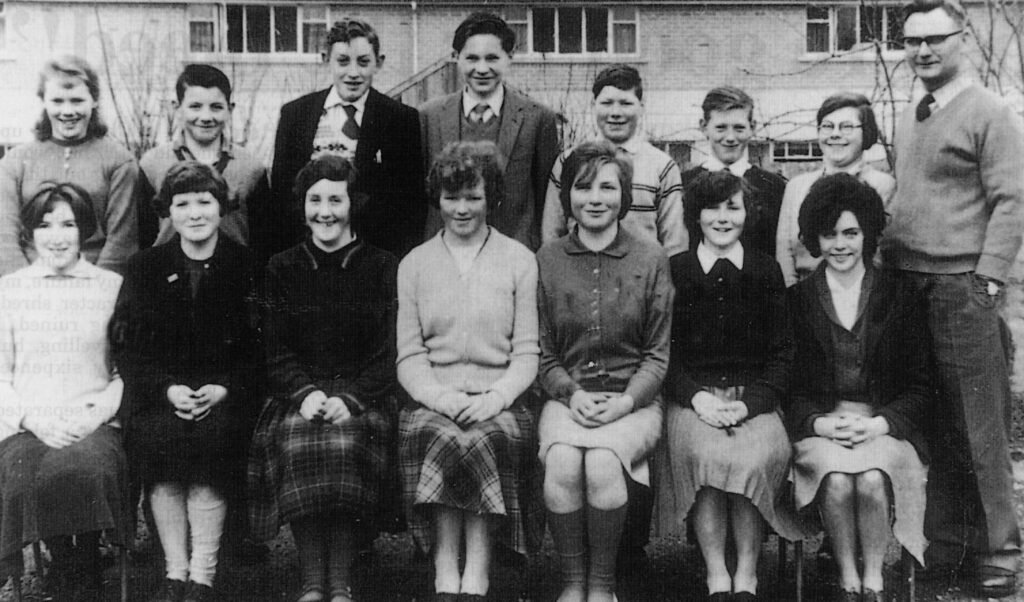
It would be a shame to leave any account of school without some reference to playtime. As I have mentioned, the girls had their own arcane rituals. The older boys mostly played football, but the younger ones had a whole repertoire of games, mostly involving dashing about at high speed. Any of these could be temporarily halted, to let someone tie his pints or whatever, by calling “Barley!” as loudly as possible, when everything would stop. The re-start was by tacit consent, without any formal procedure. Does the ‘Barley’ part from the French ‘parley’, meaning to talk, and is it just another relic of our once close links with France? The games I can recall were ‘Tackee’, which was just tag; Barley Cross which involved running from one dyke to another without being touched by ‘It’. Anyone ‘teen’ joined the ‘Its’, and ‘Barleys’ were frequent. ‘Hunt the Staigie’ involved joining hands and surrounding a ‘Staig’ (stallion), who then joined the hunters. ‘Catch the Salmon’ was something similar, and involved a bit of rope. ‘Horsies’. involved getting on someone’s back and trying to pull an opponent off his ‘horse’. ‘Kick the Tinnie’, and ‘Hoist the Green Flag’, had similar rules which I have forgotten, but both involved a wide area of play and a ‘Dell’, where the ‘Tinnie’ could be kicked or the ‘Flag’ raised. Quieter games included ‘Bools’, where the rules tended to be made up as the game progressed. One form involved a ‘caipie’ or indentation in the ground. The biggest marbles were called ‘DoIders’, and the big glass ones with coloured whorls in the centre were much prized. Wildlife was not neglected, with emertines (ants) being raced, bum bees or honey bees ‘tamed’, and grasshoppers captured. Towards the end of the war, Donald Montgomery led a local initiative to get the bus service to Aberdeen improved. Till then, there had been Tarland buses arriving in Aberdeen at 9.45am and 5.45pm, and leaving at 10am and 6 pm. This of course meant that anyone working or attending school in Aberdeen had to take lodgings there. The first addition to this service was a bus arriving in Aberdeen at 8.40am, and one leaving at 4.10pm. I was fortunate enough to be one of the first to benefit. This improvement was soon complemented by a bus shelter at the road end, and before long there were other additions to the service. Midmar had arrived.