Memories of the Thirties and Forties
The remininscences of John Duff
John Duff wrote a series of articles about Midmar for Leopard Magazine around 2003 which have now been long out of print. This is the first of a series of three.
I spent the first twenty years of my life in Midmar, and I nearly spent all of it there. When I was a toddler took a nose dive into a tank full of sharn bree that Granda had sunk into the ground at the tail of his midden to get liquid manure for the garden. My cousin and my sister, who supervising my toddling, pulled me out, well manured out and in, and were subsequently chastised. They maintain it was for the rescue, not the lack of attention. Shortly after that, I tried to befriend a swarm or bees and Mother got severely stung in her efforts at rescue.
More recently the news that a consortium had been formed to promote the attractions of the countryside between Echt and Tarland triggered off a bout of nostalgia for a world long ago crushed beneath the juggernaut of progress: a world where crops were planted in spring and harvested in autumn: where spring was redolent with the acrid smoke of burning knot-grass on neep ground, and the cries of whaup, sea-pyot (oyster-catcher) and peasie filled the ears. A world with no mains services, no commuters and few cars, telephones or strangers – where children could roam all day without fear of molestation. A world also, however, where man and beast were united in slavery to the land: of often vermin infested chaumers; of kitchie deems working from dawn till dusk, and often well beyond, with a half-day off a week if the farmer’s wife was kind; a world with the ever present spectre of illness or disablement without state aid. Nevertheless, I spent happy hours recalling a few of the incidents and characters of a childhood spent In a parish where at that time nearly everyone was either engaged in agriculture or in servicing the needs of those who were, and most motive power was supplied by steam, water, and Clydesdale horses.
When I was about six, I was playing on the kitchen floor one summer’s night when something made me look up, to find standing beside me a dripping, grisly horror of a collie with no lower jaw. A neighbouring farmer had decided to shoot his dog, botched it, and the poor half-demented beast had escaped. Fortunately our dog was away spoonging somewhere. or he would undoubtedly have attacked it. The victim was speedily hustled away and put out of its misery, and my father was so incensed that he went to the Comers, to the only public phone and sent for the police. In due course, Sandy Gilmore the Sauchen bobby arrived, complete with double barred push bike, puttees and choker collar. I don’t know what happened about the dog, but the first thing the bobby spotted was a disabled .22 rifle that my cousin in the Army had left with me for shooting marauding Indians, and he took it away with him. I thought he was really mean.
Next door to our house was my aunt Carrie’s shop. My grandfather, John Murray, had set her up in business about 1918 to provide her with an income when he retired from Mill of Hole, where he had a sawmilling business. The shop itself, which had previously also housed a tailor, was like any other country shop, and the contents, which included everything from starched dickies to stable pails, would nowadays be regarded treasure trove by social historians, but Carrie herself was more interesting.
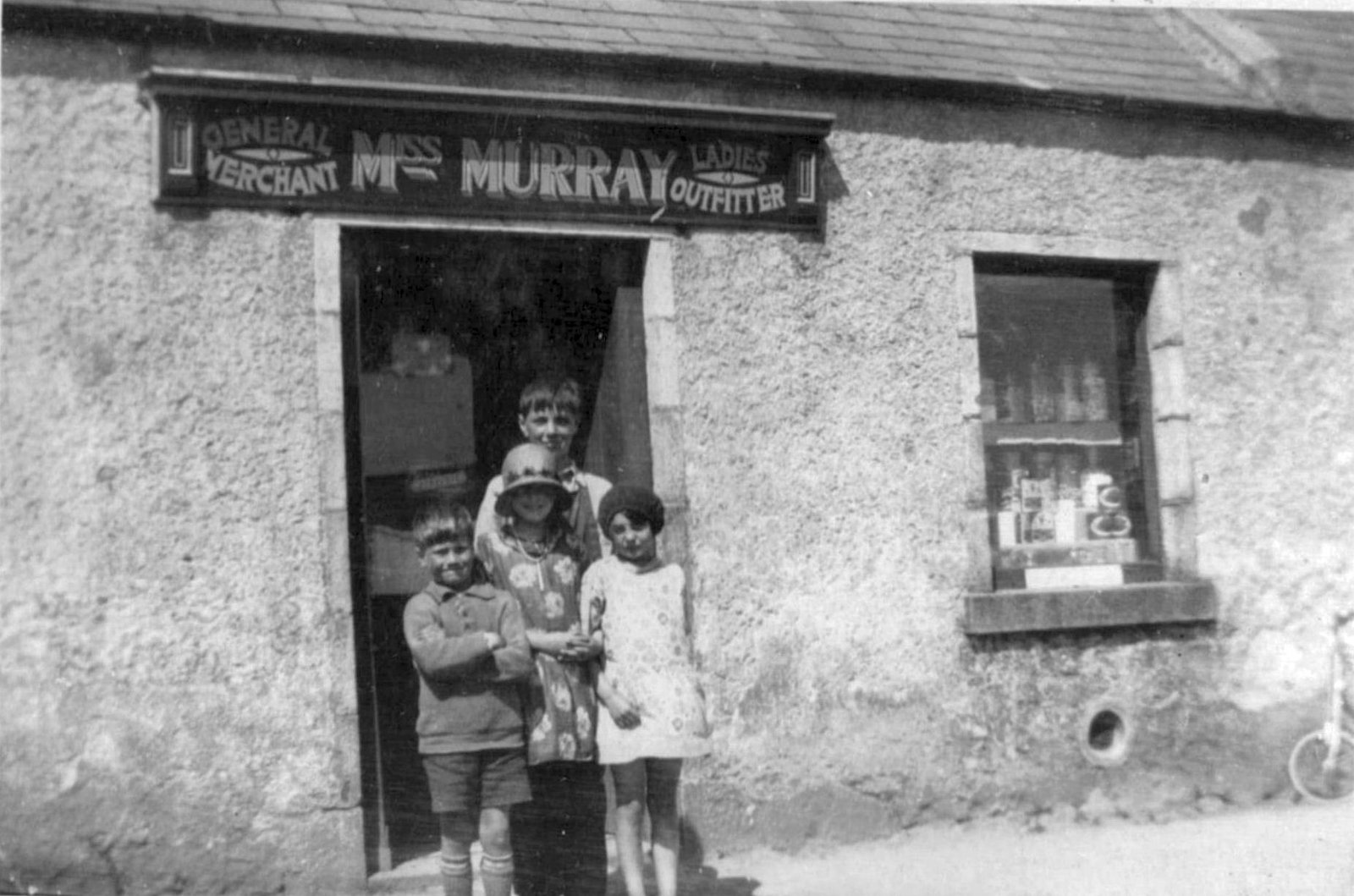
Born in 1884, the second eldest of a family of seven, (my mother was the youngest), she had never married, and having worked at home for most of her life, fancied herself as the family manager. My father, who suffered from her machinations, could cheerfully have strangled her, a sentiment no doubt shared by a succession or maids and shop girls who were sacrificed to her paranoid belief that she was always being put upon and stolen from. She seemed to have boundless energy, and despite never having ailed in her life, she was convinced that she had conquered several major illnesses by sheer will power.
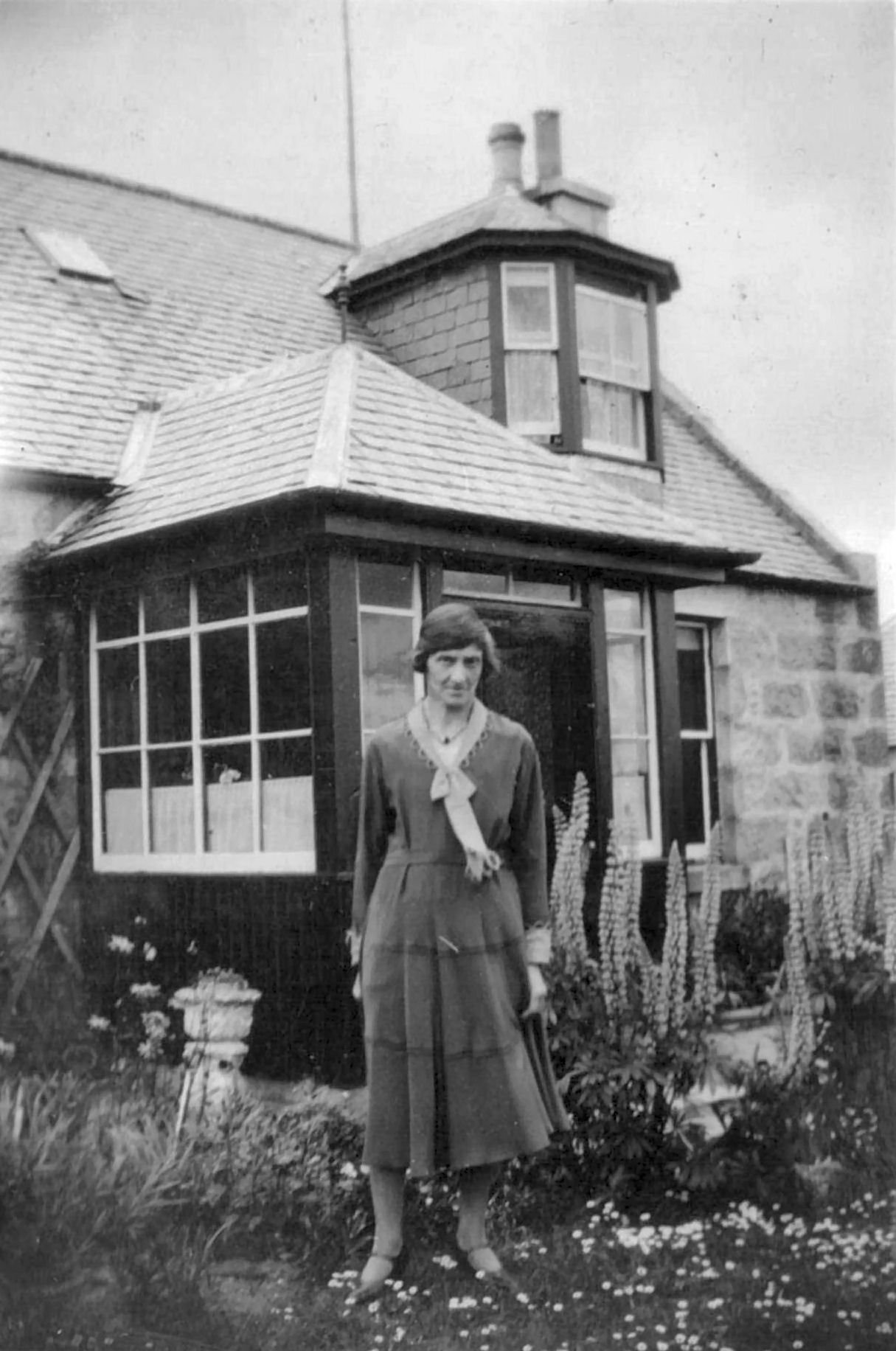
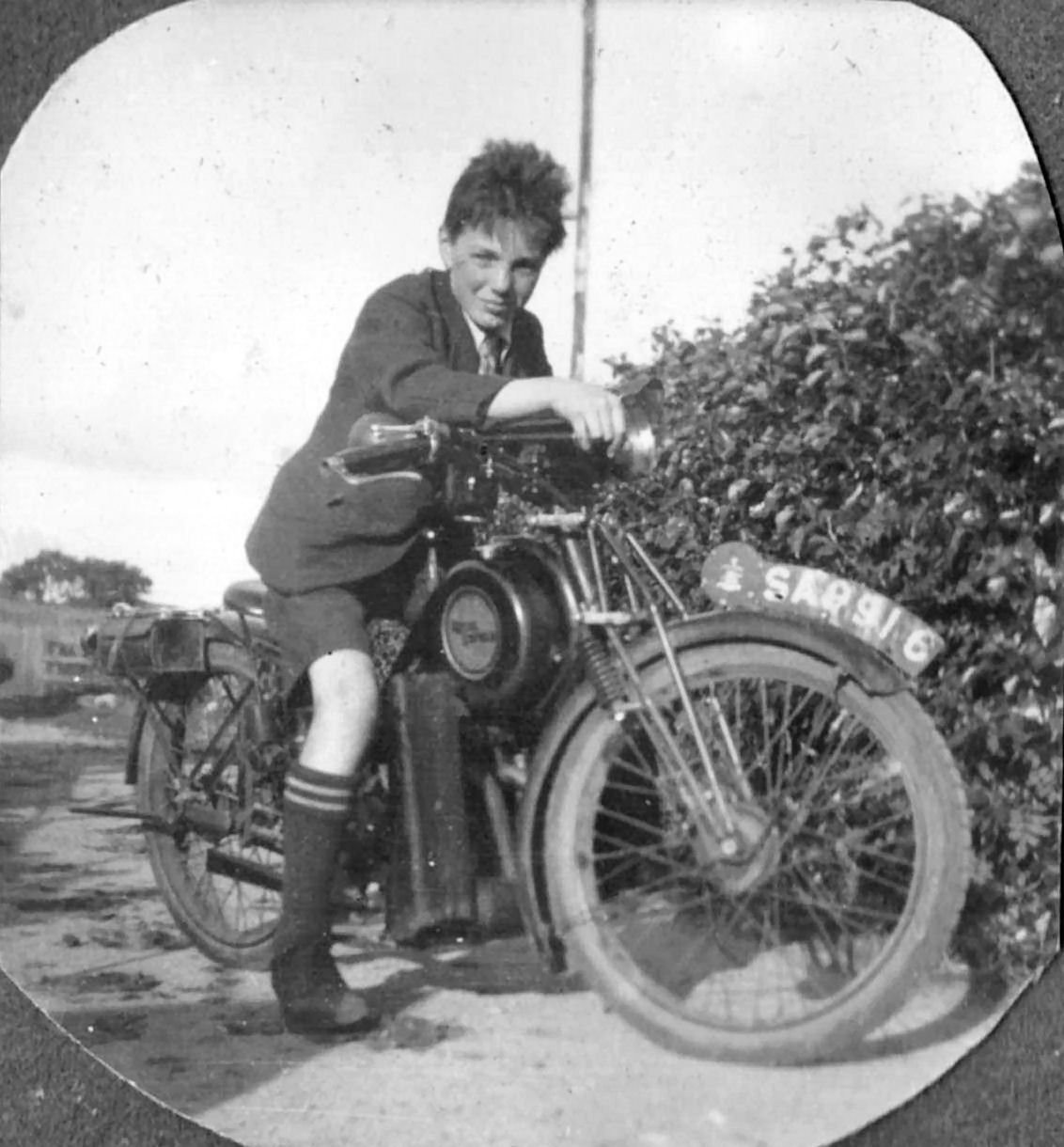
As she grew older. she did suffer from arthritis, and used to lament piteously that she could no longer raise her arm above shoulder level, immediately spoiling the effect by demonstrating how high she used to be able to lift it. She played the organ at the Free Kirk at Bankhead, and in 1928, to ease the journey, bought a Royal Enfield motor bike, thus staking a valid claim to be one of the first female north-east bikers. Unfortunately she soon fell off it and broke her collar bone, which rather damped her enthusiasm. She was still playing the same organ in the 1960s, but latterly the Minister conveyed her in his car.
Her home at Birley housed a constant stream of lodgers: woodcutters; evacuee teachers; Larry Fyffe of Corsindae up for the grouse shooting on Corrennie; Bishop Fyffe on occasion, and in between, numerous visiting family members. It was always busy, and this necessitated the employment of a maid, the unfortunate Iassie being housed in a large cupboard in the ‘crap o’ the waa’, at the top or the stairs, where a dwarf could easily stand upright. Carrie believed in being involved in community life, and spent a great deal of time in the public hall, whether at country dancing classes, WRI, dramatic productions, or just going to dances, which she kept up into her seventies. Long after retiring from the shop, she was still giving piano lessons and finally died, aged ninety four, in a Church of Scotland Home, stoutly maintaining to the last that her room-mate was stealing from her.
At Roadside Croft, near the public hall, lived Spuddy Duncan, an old retired mason. His father, also Spuddy (from his fondness for quoting from ‘Spurgeon’s Sermons’), was aged about 90 when he died in the mid 1920s and had been a drystone dyker. Spuddy often used to speak of his father having been at the building of the still magnificent boundary dyke which runs along the top of the Hill of Fare. The dykers had been paid 3d per yard, or 6d if they provided their stones. The dyke runs past the old Midmar peat moss, the road to which was behind Skybrae and Wester Tulloch, until it was washed out in a thunderstorm early in the century. The old men used to talk of chaining the cart wheels on the way down with a load, so it must have been quite strait.
The public hall on its hilltop site, meantime the subject of a projected extensive modernisation, had allegedly been built there so as to be in the centre of the Parish: certainly, leaving aside the top of the Hill of Fare, it was on the most exposed site. Alongside was a big flagpole on which the Union Jack was hoisted on Empire Day (24th May). The hall was requisitioned as a food store during War and functions were then held in the school.
The wartime concerts were notable, and were held regularly to raise funds, either for comforts for the troops or to help the war effort, and the artistes were of course all local, which made everything much better. Each act was applauded to the echo, regardless of how often it had been heard before, and it mattered not at all if the lady reciting Saut got a wee bit confused between deceased and diseased, or if one of the singers in mid verse decided to adjust the flame of the hanging lamp that he could see better. It was all our own local Soap (not that Soaps had then been thought of), and we children at least knew beyond all doubt that Midmar could produce more talent per acre than any other parish.
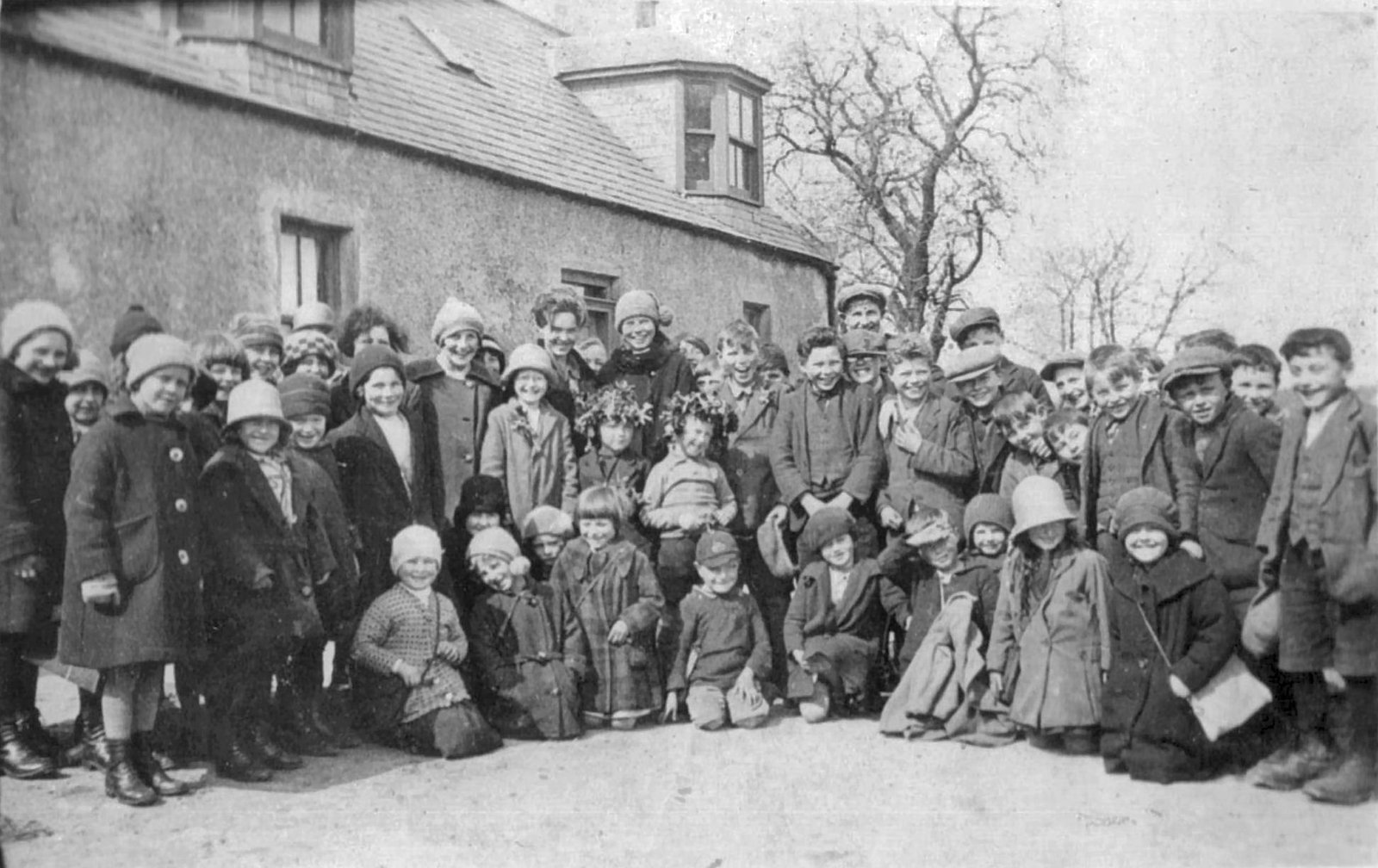
One custom which died with the war was that of choosing a May King and Queen from the infant pupils at the school (Hello, Mary !). The Royal Couple were crowned with flowers and either wheeled or carried, I forget which, to Carrie Murray’s shop, where there was a scatter of sweeties, and if anyone had a camera, photographs were taken. This took place on the Empire Day public holiday.
Much of our time as children seemed to be spent running errands, and one favourite job was to go round the neighbouring farms to warn that we were having the steam mill on such and such a day (the road mill needed about 15 men, and a ‘neighbouring system’ operated). Farmers’ wives seldom got away from the kitchen, and were always very welcoming, in addition to shamelessly pumping the messenger for any fresh gossip from home. This welcome was undoubtedly encouraged by the fact that children were then taught to be on their best behaviour, especially away from home, and to speak only when spoken to. Many were so shy as to be almost incapable of speaking to strangers. Usually there would be a jammy piece, or a bit of breid (oatcake) hot from the front or the fire, with home made butter, to shorten the journey to the next farm.
One errand which was never welcome. however, was to go to deliver a message to Davy Middleton, the contractor at Cartars. This was no reflection on Davy or his sister Maggie, with whom he lived, but on their dog, a gurly brute which used to lie in the porch, beside the open door. On the approach of a child, he never moved, just curled his lip teeth that would have been the envy of a crocodile. This triggered the dilemma of whether to return home with the message undelivered (unthinkable), or of knocking on the door and risking an attack. Fortunately, Maggie usuaIIy appeared before a final decision had to be made.
The Middletons were kirky folk, Davy being an Elder, and Maggie playing the organ in the parish Kirk. Davy had taken over the traction engines. mill and contracting business from his old boss, Davy Angus, and was a tall, quiet man, with tufts of hair growing from his ears and nostrils, we thought as a result of the dusty conditions in which he always worked. He was notorious for being an early starter, and it was frequently said that the only place he slept was at the Kirk on Sundays.
He had four engines, named Bella, Nellie, Little Beauty, and Braes O’ Mar. (Braes O’ Mar was a Burrell engine, and came to Braemar in the early 1890s. The nameplate made £60 when rouped in the 1960s. Little Beauty was an 1887 Aveling. Angus bought her at a bankrupt roup at the Three Mile – date unknown. Nellie was an Aveling, bought new in 1889. Bella was a Fowler road engine).
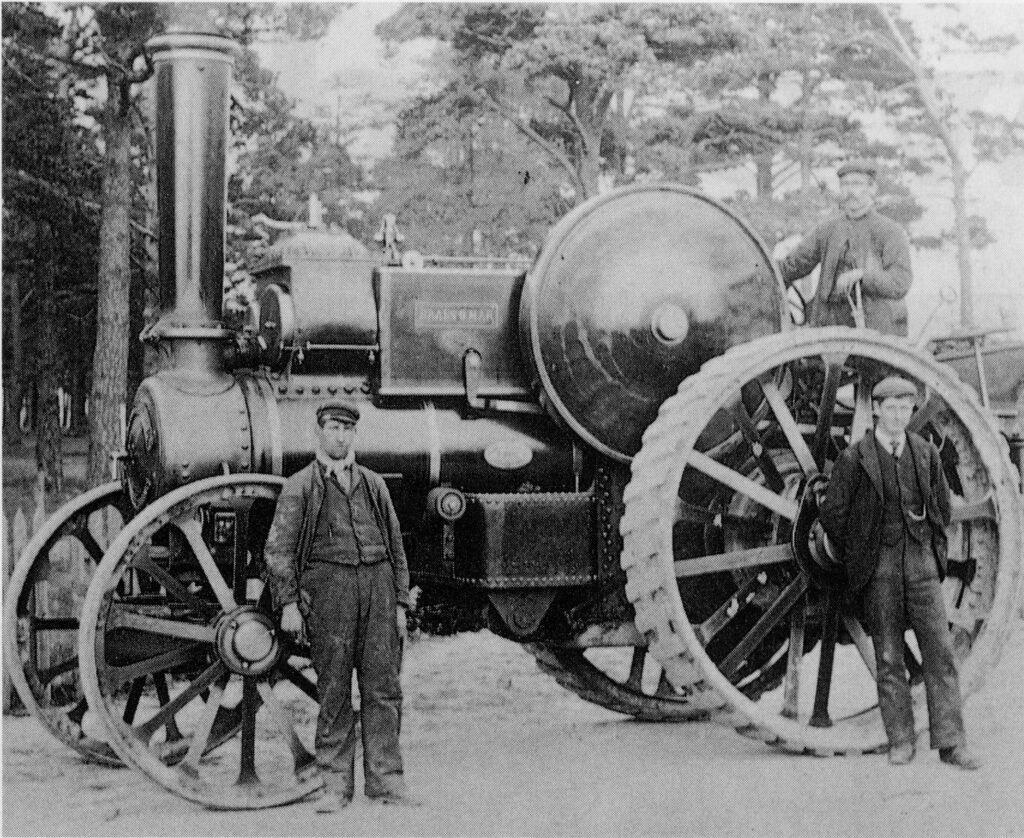
Most of them were taken for scrap during the War, but Braes O Mar, which had in fact started its working life in Braemar, was still working at his sawmill as a stationary engine in the late 1950s and possibly as late as 1960. Threshing was done in the shorter days. and it was common for the mill entourage to arrive and be set up in the dark, after finishing a full day at another farm. I have often in later years marvelled at the quiet efficiency of the mill men in negotiating the often tricky approach to a corn yard and setting up the big mill and ungainly engine, frequently on sloping ground, in the dark, with only the light of a couple or paraffin lamps to help. They seldom seemed to need to speak to each other, with Davy slowly manoeuvring his engine and Pauly, the second man, frantically screwing the steering mechanism at the back of the mill. Within minutes, the big jack would be in use, the mill levelled, the wheels chocked, the riddles cleaned and the engine set, all ready for morning. The smell of fresh straw, hot oil and steam, the reflection of flames in the cockpit, the soft hissing of the engine and the multiple flickering shadows cast by the oil lamps, could never be forgotten.
Mill day itself started long before dawn, both inside and out, because there were meals to prepare, and the byre work had to be finished long before the mill was put on. When boys, and often girls were old enough to carry a calfie’s pail full of water, they were allowed to carry water for the engine. I say allowed, because to be old enough to work at the “staem mull” was every boy’s ambition. Those a little older got to carry ‘caff’, which was stored for use in hen-houses. Those with no specific job killed rats and mice, in anarchic company with any dogs which happened to be about. The younger and stronger men would generally be at the tail of the mill, weighing and carrying corn. This could be a very hard job indeed, depending on the ‘run’ or yield, and whether it had to go into an upstairs loft. The grain was put in half quarter sacks, with corn (oats) at 168lbs (76.2kg) and barley at 224lbs (101.6kg) per sack. There was always a great deal of banter and practical joking at the corn, a favourite trick being to bury a 56lb (25.4kg) weight in a sack of grain in the hope that some unsuspecting soul would carry it. Big Flo Anderson, a Midmar institution in her own right, was very often to be found on the platform of the mill, happily lousing shales and verbally giving as good as she got from the men around.
Our own barn mill and corn bruiser were driven by a Ruston-Hornsby paraffin engine of ancient vintage. Although only producing about 5hp, it and the associated 150 gallon cooling tank required a shed for themselves. The starting procedure was lengthy. and consisted of first heating and lighting a huge blow lamp which, in tum, heated the vaporising bulb at the end of the single cylinder. When everything was judged to be hot enough, paraffin was pumped into the cylinder and the big flywheel spun by hand, when with luck there would be ignition. Frequently, pre-ignition would drive the flywheel backwards with considerable force, and this had to be watched, as the engine would happily run in reverse, but without a governor. If everything was going to plan, the Operator would then hurriedly pump more paraffin till the engine gathered speed, when a roller cog would be moved to engage the automatic fuel pump. When the mill was on, the distinctive ‘chook-chook’ of the engine could be heard for a considerable distance.
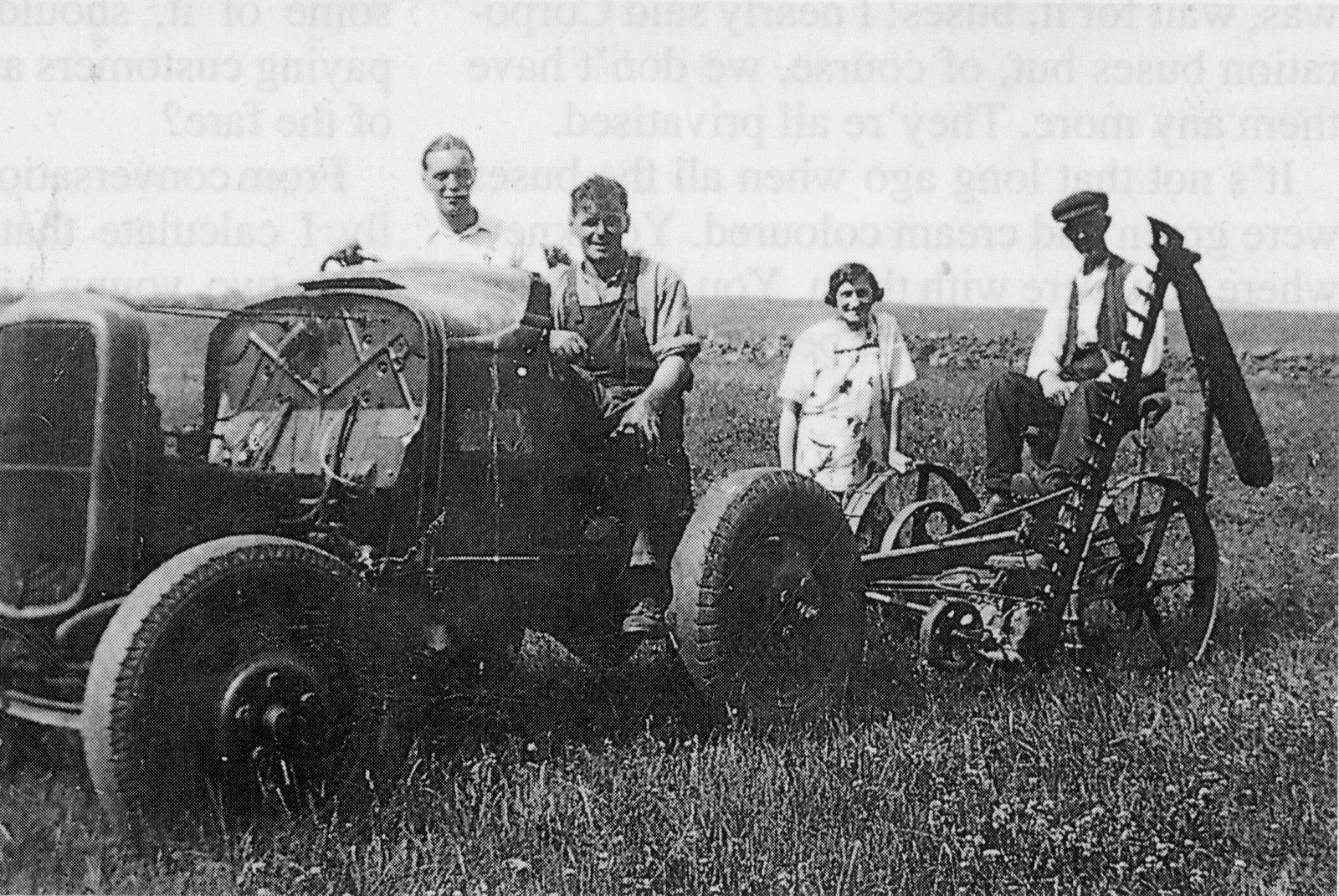
Birley was a one-pair place, and tasks like grubbering or hindering, which often required three horses. could be very hard on two. In an effort to overcome this difficulty, my father in the mid thirties bought an old motor lorry, removed the body and shortened the chassis and turned it into a rudimentary tractor. It retained the smooth road tyres, and to improve traction for heavy work, iron cleated bands could be fitted over the rear tyres, held in place by deflating and then reinflating the lyres. It worked quite well till we got an iron wheeled Fordson during the war, and it then went for scrap.
John Scott in Wateridgemuir was one of the progressive farmers in the parish. Progressive, but a wee bittie roch! He was the first locally to outwinter cattle. and devised his own system of self-help feeding. He gave them access to a hay ruck they ate away at till it became unstable and collapsed, killing a cow which was discovered only when the carcass started to appear through the debris. He was the first to use a combine harvester, I think in 1947, and we went down to watch it working in a field near Corsindae. He was also a pioneer in reseeding rough ground, and transformed the broom hill behind the hall, at the same time depriving the courting couples of their cover! John was an angular man with a big coulter of a nose and a voice like a rusty hinge. A good singer and a willing performer at all the concerts and dramatics, he often sang with Bob Milne the butcher and John Hunter in Skybrae.
The three bachelor Ross brothers, Alan, Jim and Bill, farmed in Easter Tulloch, and if John Scott was progressive, they were equally conservative. Alan was housekeeper, while Bill and Jim were the outside men, both champion horse ploughmen.
Their neighbour in the Brae was Sandy Forbes (we always pronounced it Forbis, in the old style). Sandy’s son, also Sandy was a dedicated machinery and tractor man (he was a talented joiner and engineer as well. but that is another story), much more concerned with blackening ground than with setting up tidy feerings. This sacrilege affronted the brothers, especially since they overlooked the Brae ground, and eventually Jim was moved to approach Sandy senior direct. Buttonholing him at the mart one day. he blurted out his concern, “Brae”, he said, “That loon’l ploo ye oot o’ yer place yet”.
He didn’t, but in another sense mechanisation was the death of Old Brae, who died years later in a fall from a tractor cart. Ironically, the Ross brothers’ successor at the Tulloch was another tractor enthusiast, uninterested in the finer points of ploughing, and whose furrs Bill described as being like serpents in agony.
The souters shop was an important piece in the Parish jigsaw. The souter was Fred Willox, but he was always just “The Souter”. Having been badly wounded in the Great War, he had become a souter, which allowed him usually to sit as he worked. His shoppie was a tarred wooden shed beside his house, just below the smiddy. It was divided in two, with the new footwear in one part and the workshop in the other, and rich with the aroma of new leather.
He was not a very newsy man, and sometimes he would be engaged in something he did not want to interrupt, and so could be watched for a while. One of the most intriguing sights was of him making ‘rozzity eins’ (resin/wax coated threads), fitting boar’s bristles on the ends, and then rolling them his knee to finish them. They were used with an awl for sewing soles and other heavy stitching. The souter also ran the only local hire car, which doubled an emergency ambulance. The bike-shop was his third venture, and was usually opened in the evenings, looked after by his younger son Gerry. It stocked bicycle tyres, patching and spares, and Gerry sometimes carried out minor repairs. Bottles of ‘ale’ (lemonade) and cigarettes were available, so it was something of a focal point for youngsters. I had my first Woodbine there. cadged off ‘Clarty’, an older boy, and of course someone clyped. Mother was not amused and threatened to tell father, which would have been a very serious escalation indeed.
The smiddy was at the top of the Comers brae, and in fact stood at the Dee/Don watershed, as the Comers Burn goes to the Don, and Jimmy Wood’s Burn to the Dee. An old smiddy road, which we called The Loaning, branched off the public road at the school, and was well used both by pupils and by horse traffic from the north-east side of the parish. There were two forges, but I only ever saw one smith working there. There a succession of smiths, Sandy Adam, who retired in the early thirties, was followed by George Esslemont, then Dave Lawson, a big. easy-going man, and lastly, Bill Forsyth, an ex-serviceman who was to have a sad end, gassed by carbon monoxide in the kirk boilerhouse.
By that time, smiths had been largely replaced by the more versatile and mobile agricultural engineers, and there was simply no living to be made from traditional smithing. A visit to the smiddy was about the most desirable of all errands. Again, boys were not encouraged to hang about, but if you were there with a culter to sharpen, or perhaps a sock to sharpen and lay, a leaky milk pail to solder, or best of all, entrusted to take a docile horse to be shod, it was all right to stay and watch the work. The forge-welding of lumps of iron on to a culter or sock entailed showers of white-hot sparks, and was exciting, but the making of the horse shoe, followed by the fitting, with clouds of smoke from the singeing hoof, the paring, nailing, rasping and finally painting with oil took longer, and was best value.
Farm horses always seem to be described in print as ‘gentle giants’, and most were fairly placid, but a nervous or bad-tempered beast of that size, especially with iron-shod hooves the size dinner plates, was no joke, and not to tackled by the faint-hearted. Outside the smiddy was the trevis, an arrangement of four stout tree trunks with crossbars for securing unmanageable beasts, the bending machine for making iron cart rings, and the flat ringing stone where the rings were fitted to the wooden wheels.
The more I write, the more the old familiar faces and events crowd round, each with its own tale to tell – the school and the teachers; the evacuees: the doctor; the joiner; the storms: the list goes on and on, but there is no space – they have to wait.
Copyright John Duff 2003